How to regenerate inclusively

by Francesca Perry

Reading the spot-on article by Loretta Lees about the damaging effect of regeneration in London got me thinking. Regeneration has become a dirty word. But good regeneration is not about ‘bringing back to life’ – life is always there – it is about supporting and enabling, making positive change to benefit everyone.

Listen to the community

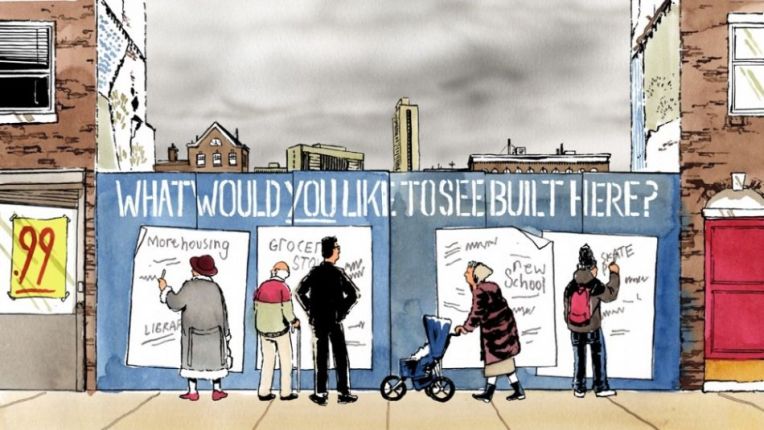
As a developer, this may not come naturally! Those practitioners involved in change should be aware of multiple narratives and needs and if necessary, bring someone on board who can responsively engage with the community, understanding how they feel and what they want. The local and existing community in a place should be involved at every step of a development or change to help shape it. Crowdsource ideas from the people that know and use the area – they are the experts!

Support services

A lot of the time, a place doesn’t need an injection of luxury landscaping to ‘improve’. Look closer and you’ll realise that vital community services – whether it’s running a family centre or maintaining a local park – may be in need of support, time and money. This sort of support is often the section 106 ‘afterthought’ of a pricey development – but developers tend to put money towards their own version of what’s beneficial, rather than the community’s.

Integrate housing

It sounds so obvious – but it rarely happens. There are so many excuses for separating social housing from private housing, but there is no excuse for creating a segregated city. Rent and sale prices in London are becoming increasingly exclusive – and ridiculous. We urgently need to decelerate something that is spiralling out of control – as Lees articulates, this property-led regeneration – leading to a city dominated by unaffordable luxury housing.

What’s appalling is that even if social housing is built in the same development as private, often the quality of the buildings is so markedly different as to be offensive. Additionally, developers and local authorities should ensure new housing is not only integrated within itself, but also with the surrounding existing communities and spaces. Create communal spaces for all to use, including community centres, family facilities and open green spaces where collaborative activities like sports and social groups can take place. Nurture place, don’t displace.

Help build pride and community

I’d like to think that community is not, contrary to popular belief, built through ‘place branding’ tactics! Real collaborative and productive local projects can achieve great connections and improvements. From communal gardening and urban agriculture to public art projects and youth initiatives, it is important to help enable people to both get involved and run activities themselves. Public space plays a crucial role in these processes, and really it is accessible public space that needs to be nurtured to achieve inclusive regeneration.

Target additions

Sometimes additions are needed. By this I don’t necessarily mean another Tesco Metro or a cafe that charges £4 for a coffee. Is it possible to contribute a community space, healthcare facility, or a skills training centre? Respond to existing and very real needs that, if catered for, will greatly improve the wellbeing of the people and their place.

Enhance training and employment opportunities

Ensure existing and any new businesses provide opportunities to local people for apprenticeships, training and employment, working with local schools and colleges to achieve this. Places like Free 2 Learn are crucial too. In London especially, when I talk to young people about what they want to see in their local area, I hear this again and again: more training, more work experience, more jobs.

I want more than anything to believe there is a better way; we can grow and support our city without being exclusionary and divisive. More holistic and sensitive regeneration is the bigger win in the long term. Listen to the multitude of diverse voices: this city belongs to all of us.
Do we need a Chief Built Environment Adviser?

Building Design

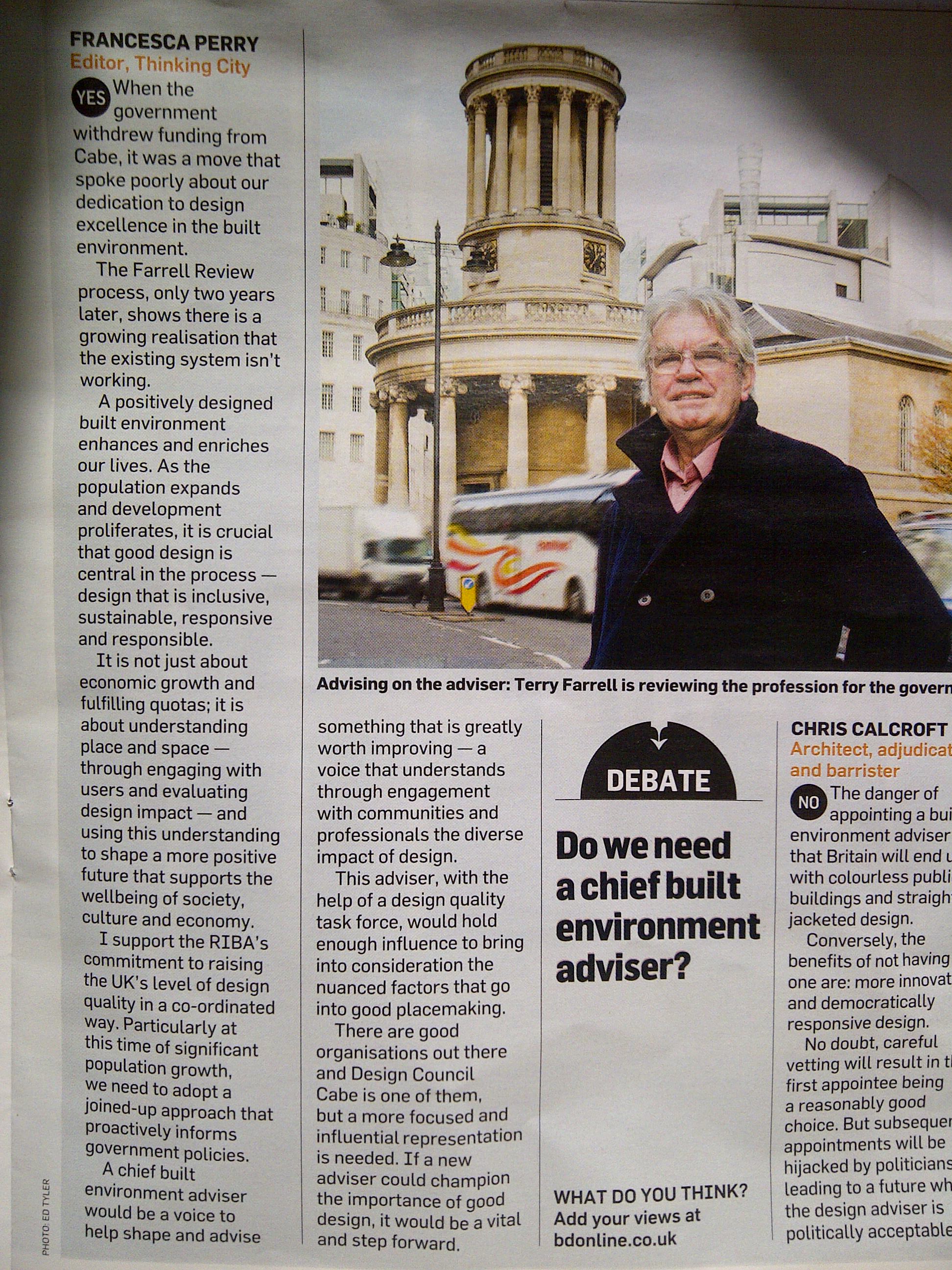
‘A positively-designed built environment enhances and enriches our lives. As population rapidly expands and development proliferates, it is crucial that good design is central in the process – design that is inclusive, sustainable, responsive and responsible.’

– –

This month I wrote an opinion piece for the debate in Building Design over whether the UK would benefit from a Chief Built Environment Adviser to the government, as recommended by RIBA in their response to The Farrell Review. The full debate can be found here. What are your thoughts?

Key Ideas from Future of Places

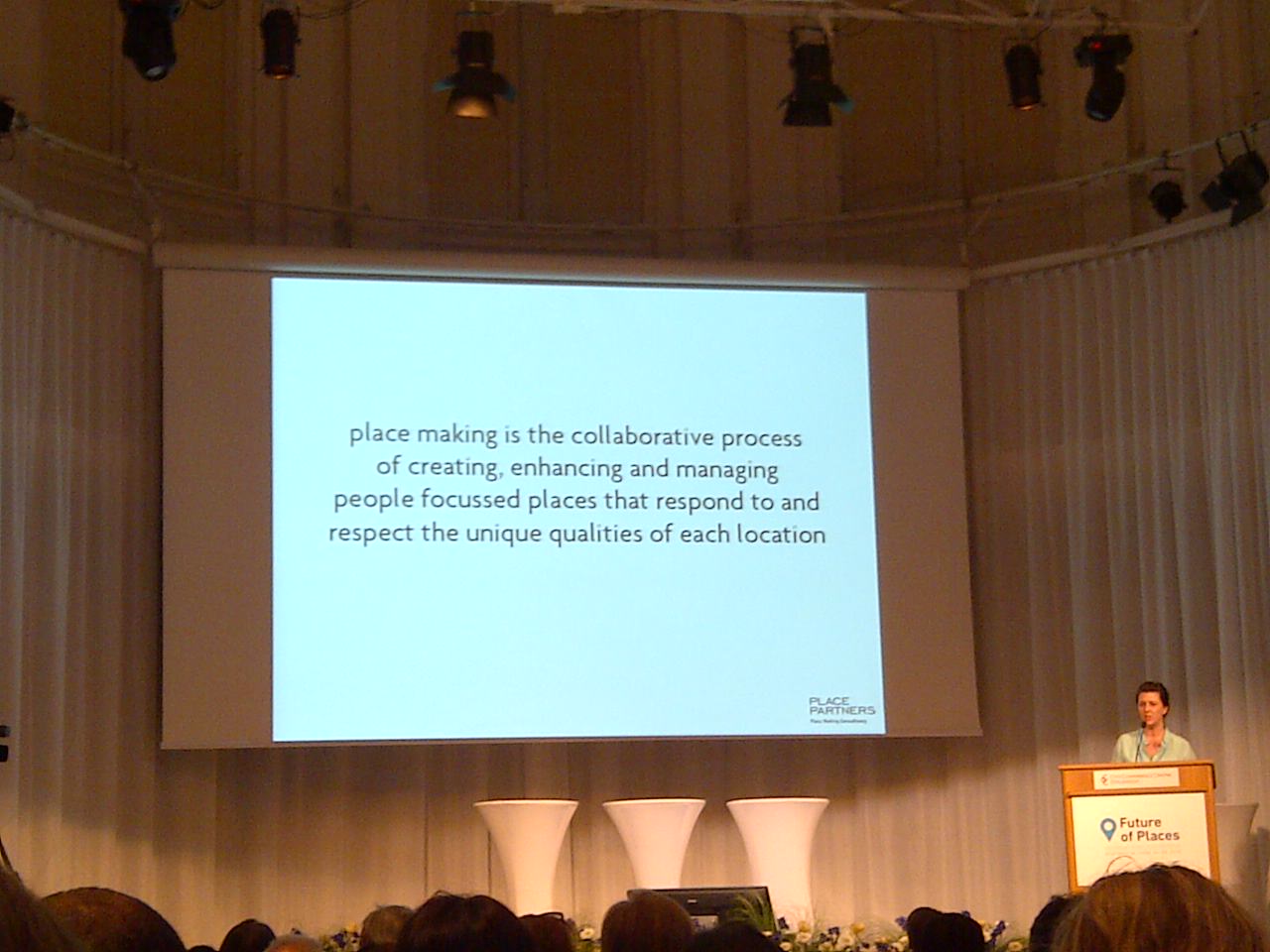
Place Partners speaking at Future of Places

I recently returned from an intensive 3-day conference in Stockholm entitled ‘The Future of Places’. Co-organised by Project for Public Spaces and UN Habitat in the lead up to the much-anticipated UN Habitat III, the event brought together urbanists, academics, practitioners, students, experts and everyone in between from 50 countries around the globe. Stories were shared, challenges were addressed and voices were heard. Below I have tried to think about the key messages that came out of our discussions – the important things to remember when creating, supporting or enhancing public space:

A people-centred approach: The UN Habitat’s primary message was that with such rapid global urbanisation – 200,000 people move to cities each day – the only way that places are going to work is if we adopt a people-centred, integrated approach to development and management.

Time for change: This people-oriented approach means reforming the way cities are planned and managed. If we don’t make cities that work for their inhabitants, human rights will be diminished and social unrest will undoubtedly rise. The Urban Think Tank made clear that we still have a long way to go to make cities truly sustainable, tolerant, equal, balanced and connected. Dr Narang Suri asserted that cities today are undertaking investment that is not for everyone – but at the cost of the resources that belong to everyone.  The drivers of wealth are promoting the homogenisation of public spaces – how do we deal with this?

The community is the expert: This simple and crucial idea was outlined by PPS and many others: people need to be involved in a genuine and integrated way. Crowdsource ideas for making place because we are making spaces for the public, not just the professionals.

Be experimental: A theme that repeatedly emerged was the need to be experimental, though a qualitative scale of this experimentation was not explored. We need to allow space for new and innovative things to happen. Tactical urbanism is a form of this experimental approach, but it should be complemented, as Place Partners noted, by strategic and opportunistic methods.

Access, access, access: The buzzword of the conference – and rightfully so – was access; accessibility, as Ali Madanipour and others argued, is the key feature of good public space. Boundaries suggest inequality and fear – even overdesigning a space can limit access to it. Only through making truly accessible spaces can we move towards a more inclusive city.

Build partnerships: The simple fact is that a lot of future public space will be provided by private developments. Clever and collaborative partnerships need to be made across the public and private sectors as well as the community to ensure that space created is collaborative, contextual and democratic.

Don’t build objects, build places!: As Paul Murrain made clear, good placemaking isn’t just about THINGS – it’s a much more joined-up, contextual and nuanced approach.

Make places a joy to the senses: The experiential nature of public space was discussed, with an inspiring David Sim from Gehl Architects articulating how we experience the world through our senses. Place should be more interested in a richness of experience than of its people.

‘Lighter, quicker, cheaper’: This approach to placemaking was driven home by PPS. In this age of austerity, it’s certainly vital we learn how to do more with less. Making small, appropriate improvements is key.

Recognise what’s there: Suzanne Hall put forward this vital starting point – that we build on and support what already exists when approaching a place rather than simply changing it. Start by understanding the needs and the stories, and build this in to the process.

Build capacity: This emerged again and again: capacity needs to be built in the government, private sector and community to approach a more effective placemaking strategy. It’s a huge but vital challenge. The community should have the capability to make it their process: they will be empowered through organisation.

Don’t copy success stories: Again this related to the need to always be contextual; Place Partners highlighted the danger of trends such as the ‘High Line Fever’ that assume universal narratives in place.

There was far more but I believe that provides a good taster of the important discussions we had.

It is not about traditional vs temporary / formal vs informal, because dichotomies won’t help us get to a more sustainable future. There needs to be a joined-up approach that promotes partnership. My phrase would be ‘inspiration not instruction’: be inspired by people and place, and in turn inspire others. It is not always about stringent rules. It’s about a conversation.

Gezi Park and why public space matters

by Francesca Perry

taksim_gezi_park_4_1

Although the biggest and most crucial story to come out of the Istanbul protests is the completely shocking and violent police treatment of the peaceful protesters, one that I find so gripping is the unity of citizens to protect and defend their public space.

Much of the Occupy movement has seen the use of space to protest against non-spatial issues, but this is about protecting the public realm itself and what it stands for: sharing the city, civic freedom, urban wellbeing, belief in the very public it creates a space for. Beyond protecting trees, this is about the democratic right to the city.

Space is where it starts. Space to think, to be, to interact. Working in public consultation for urban regeneration as I do, I passionately defend a community’s say in how their city develops and what their city means. To not take into account the needs and lives of the public is to dismiss the citizens entirely from the notion of a city. It is the citizens that make these places into cities. The streets, the squares, the parks – these are our spaces where we can be human, together. They are worth defending, worth protecting. Turkey’s police response across the country to these protests cast themselves as villains of civility and urban life itself.

Many have written about the dangers of privatising public space, even when it remains ‘open’. To replace democratic public realm with controlled space drains the city of its vitality and honesty. Spaces are increasingly surveilled, commercialised and exclusive, welcoming a restricted public of appropriately behaved consumers. Through these processes, neoliberal interests are prioritised at the expense of social justice.

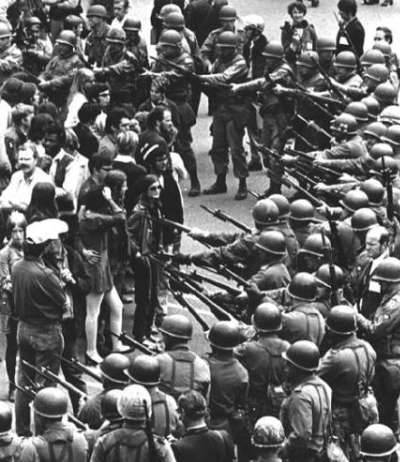
But this is not new: public space has and always will be contested. What has happened with Gezi Park reminded me of People’s Park in Berkeley, 1969. When protesters tried to defend the park from redevelopment, ‘Bloody Thursday’ ensued, in which police fired tear gas, killed a student and were authorised to use whatever methods they chose against the protesters. For two weeks, Governor Reagan kept 2,700 National Guard troops in Berkeley, who continued to use teargas against even small demonstrations.

People's Park

After years of contestation, confrontation and threats of development, the People’s Park remains just that: a park for all. It continues to be defended as a democratic place of political activism, unmediated interaction and access.

Such egalitarian public space is needed to facilitate social interaction, inclusion, representation, political mobilisation and expression. To sacrifice not just the space, but the democracy of the city itself, is the perfect example of how misguided urbanisation will lead to cities running themselves in to the ground – or rather, into the air conditioned tomb of a shopping mall.

———————————–

With thanks to Izzy Finkel, writer, editor and friend based in London and Istanbul.

See her article in Salon: ‘Istanbul Protest is – and is not – about the trees’ 


Makers in spaces: new urban manufacturing and its role in placemaking

by Francesca Perry

C-Base

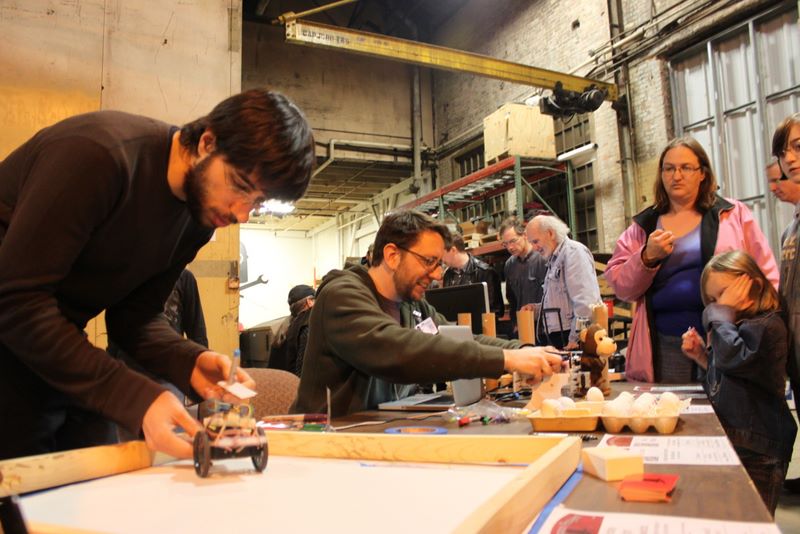
Whilst we all accept a shift in the urban economy from manufacturing to knowledge and communications, it would be foolish to say that manufacturing does not take place, matter or play a continuing role in urban centres. But this new post-industrial wave of urban manufacturing is independent, local and DIY; centred on the growth of tech innovation and entrepreneurialism rather than mass production. This is about citizen empowerment to make change through making itself.

So exactly what role can manufacturing play in place-making and community development? It can unite people in the process of making, as a form of socially productive production. It can also bring life to urban centres long starved of manufacturing activity. This is specific urban manufacturing that responds to new ways of working and doing, and in turn has the potential to make new places and community hubs. Whilst there have already been big steps forward, there is still a way to go to marry urban design and places with contemporary communities and activities. An example of this is the disjuncture between the much-lauded Tech City in London and its ugly pedestrian-unfriendly home, the Old Street roundabout. Spaces should reflect and nurture their communities, in relation to work as well as home.

NYC Resistor

After zoning and cars pushed manufacturing activities out of city centres and into what would often come to be termed as industrial wastelands, a certain diversity of urban life was lost. It also resulted, along with the evolution of services, in a number of vacant spaces in cities, emptied of their former industrial use. Warehouses, factories, mills and workshops stood unused. Though many of these faced a fate of luxurious conversion, the recent effects of the economic recession has only added empty retail units to the list.

So, what do you do with vacant urban spaces and a new movement of digital and entrepreneurial industry? The answer is makerspaces – or hackspaces: hubs where people come together to create, collaborate, make and share (see César Reyes Nájera’s great article). Now these activities are beginning to animate urban districts, supporting an enhanced diversity of use.

The digitisation of – well, everything – has led critics to believe that physical space and proximity is less important for successful business and industry. But this is far from the case. We live in cities in order that we might interact and share: computers will not change this. So of course the new ‘industrial revolution’, as Chris Anderson calls it, composed of start-ups and independent makers, requires new kinds of physical community and productive spaces.

Milwuakee Makerspace

Whether you call them co-working spaces, workshops, hubs, hackspaces or makerspaces, they are becoming vital to this new economy. Now, I’m not just talking about tech, as seductive as this would be, because physical manufacturing and crafts still take place – to an increasing degree in fact. In this post-industrial age, we have a heightened interest in the hyperlocal product – whether it be coffee, beer, clothing or furniture.

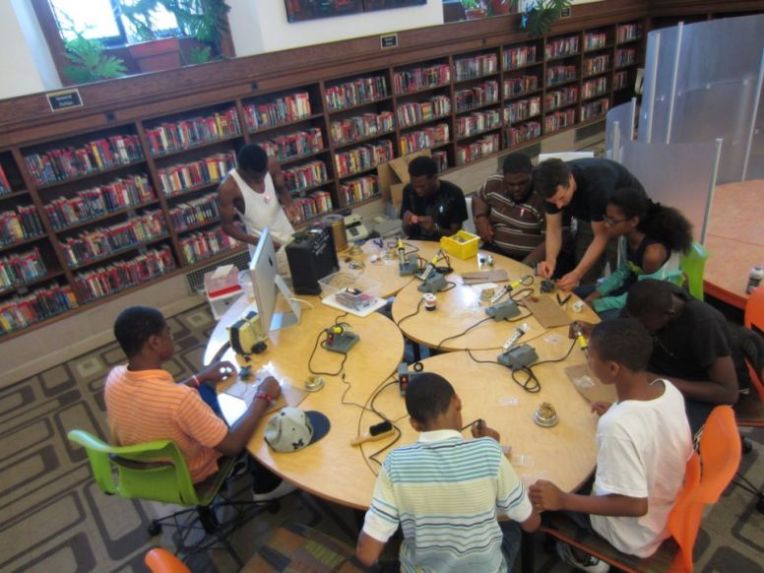
We need to embrace this movement in to the thriving network and places of urban activity. Many maker groups are indeed taking on new spaces in the city and transforming them; others are growing out of or tacking on to existing public spaces like libraries:

Recently many libraries have begun to develop spaces for design and activities that both teach and empower patrons. The learning in these spaces varies wildly–from home bicycle repair, to using 3D printers, to building model airplanes. Fittingly, they are called makerspaces.’

Library Makerspace

Over in the US, June’s National Day of Civic Hacking aims to bring together citizens and entrepreneurs to collaboratively create, build, and invent new solutions to challenges relevant to neighborhoods and cities. Initiatives like the maker education initiative are nurturing opportunities for young people to get involved in this maker movement, fostering creativity and learning. Of course, the rise of technology has made the process of making and manufacturing more accessible, with 3D printing breaking down the barrier between idea and creation. These are new ways of making for new ways of working. It’s only sensible that urban development supports and reflects this, as the physical reflects the social and must always learn from it.

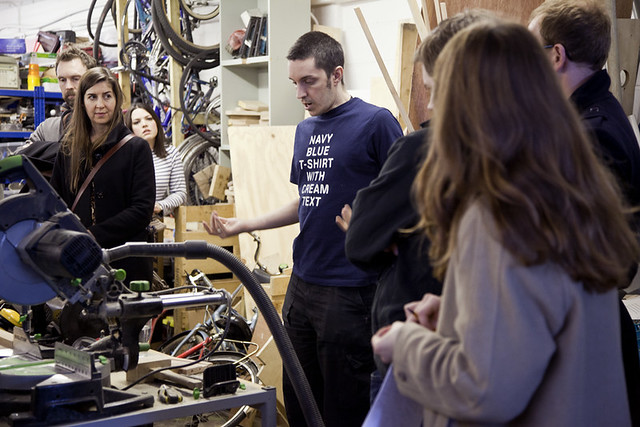
It’s crucial for makerspaces themselves to interact with the wider urban area and community – there’s little point in making a great place which remains internal and exclusive. Some are heading in the right direction. On the tech front, London Hackspace, a ‘community-run workshop where people come to share tools and knowledge’ holds regular open evenings and public events.

London Hackspace

Sugarhouse Studios in Stratford has used an abandoned warehouse to be a community hub and productive workshop, to give the opportunity to the local community to get more actively and creatively engaged with both existing and future public spaces in the area.

A great model has been Assemble & Join, who run community micro-manufacturing workshops that re-imagine the role a high street can take within a community and in turn the role a community can play in the way an area develops over time. Through free site-specific workshops, the organisation offers shopkeepers, residents, traders and community groups the chance to collectively research, design and build changes to the public realm to better suit their needs. This includes everything from wayfinding schemes and flat-pack market stalls and seating systems. A&J are using manufacturing to help communities play a more active role in shaping where they live and work.

A&J

If A&J is anything to go by, this maker movement has the potential to form a core of urban regeneration, animating empty spaces and opening themselves up as productive interactive hubs, engaged in high street life, public places and community. In the longer term, they can lead to the creation of new jobs and encourage young people to feel empowered and inspired to make their own opportunities – and products.

So far, in general, the city has reflected this new start-up, entrepreneurial DIY movement in the ‘pop-up’ culture, but it’s time we support this new economic and social infrastructure and make places for new kinds of community and business interaction.

The old form of work and making has long been behind closed doors and on city outskirts. Now, more accessible and mixed in with all other urban activities, it stands to become more fully integrated in both the social and design aspects of the city. Reflecting the new entrepreneurial spirit, we should embrace making and makers in urban life and placemaking itself. It may sound as if I’m arguing for a Berlinification of cities – but I know many places which could benefit from such an approach!

6

School’s out: from registration to regeneration

by Francesca Perry

Activities-Multisports-600x400.jpg

Adaptive reuse in cities is nothing new. ‘Saved’ historical buildings find new purposes all the time, often as long as there is commercial gain involved. Former school buildings tend to be converted into contemporary art galleries or luxury accommodation. But what about those newer sites? City schools that have had to shut down or move due to financial or practical pressures, leaving behind whole complexes at once poignant and unusable.

One place that sets an admirable standard is the former Lilian Baylis School in Lambeth, London. The school moved to a new site in 2005, deserting a complex of 1960s buildings. But instead of another case of luxury redevelopment, the local community ensured that it was transformed in to a sports hub, offering enhanced services to people living on the local estates and surrounding areas. Starting as a summer programme, four sports halls were opened and became a new centre for sports, health and community locally. The summer programme gained support and grew in to sustained activity run by Sport Action Zone, later renamed Community Action Zone.

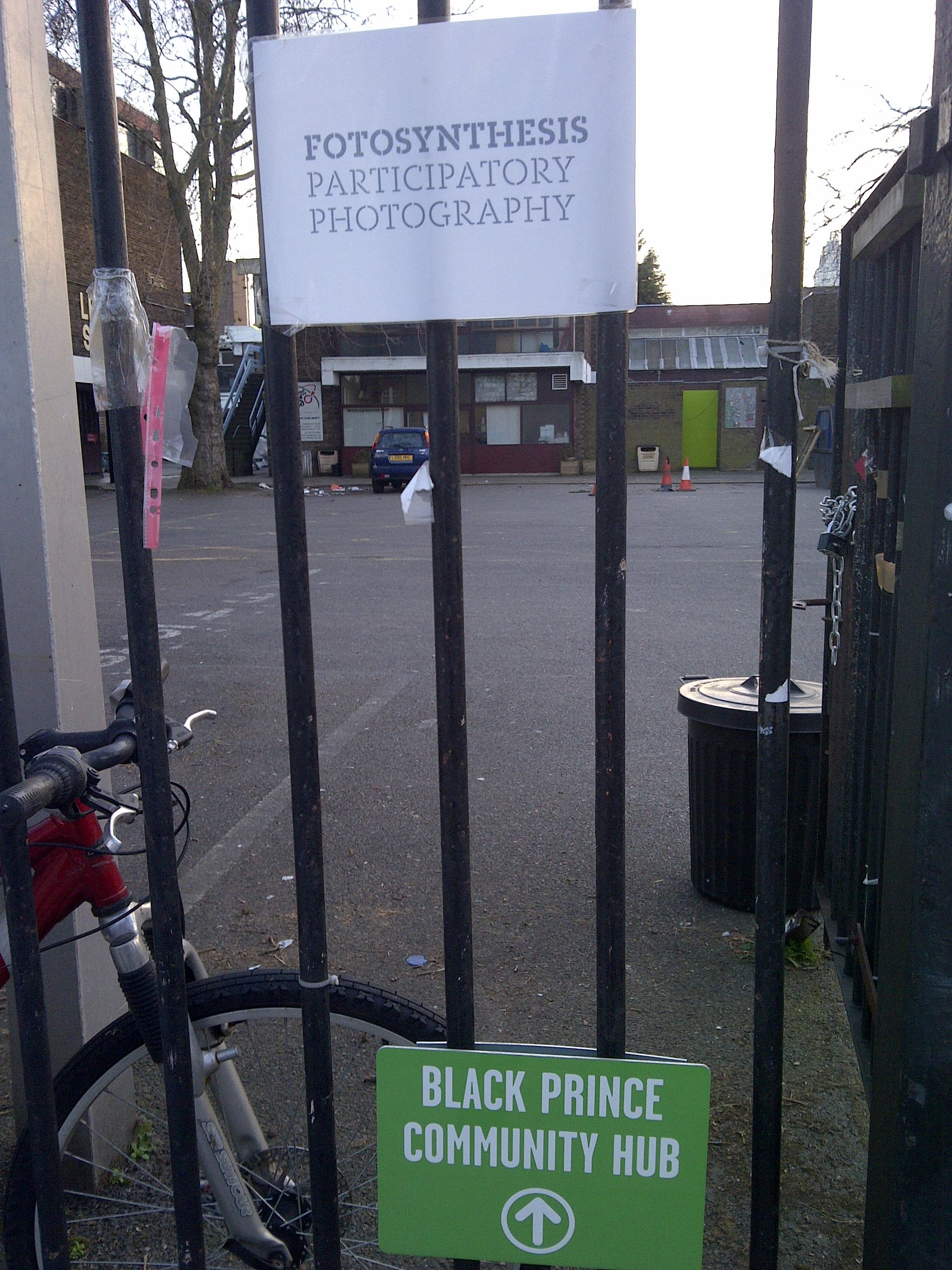
Now re-launched as the Black Prince Community Hub with improved facilities and a neighbourhood cafe, the place is undeniably a crucial local asset for youth provision, health and community cohesion in the middle of London. The old classrooms have been opened up and host an array of social, educational and cultural activities. Classes are run by the local Albanian, Eritrean and Somalian communities. Organisations that use arts to encourage community cohesion and empowerment have made the hub their home, including Creative Sparkworks and Fotosynthesis. The true community value of what is offered here far, far outweighs the potential commerical value of the site (developers take note).

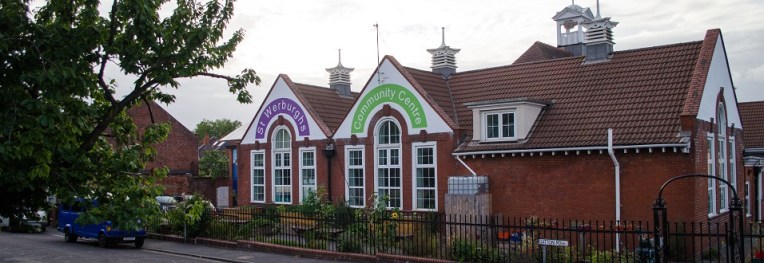
Elsewhere, it’s comforting to know former schools are being used as crucial community hubs. The One Love Community Centre in Newham, a converted school building, provides training, childcare, and seeks to enhance employment and education opportunities for ethnic minorities locally. The St Werburghs Community Centre in Bristol, another former school complex, provides spaces and facilities for community groups and organisations, building local partnerships through events and projects.

building

A closed-down school in San Antonio, Texas, was recently ‘reborn’ as a Girl Scouts Leadership Center. Having been closed due to state funding cuts, the school is now a safe and vital hub for girls, Scout leaders and families. What’s also great is to see the process reversed: a disused community centre in Newport, Wales, could soon be converted to provide a nursery for an adjacent school.

While it’s great that in cities today, disused spaces become pop-up places in wait of development, and newly vacant properties can be part of residential guardianship schemes, it takes something else entirely to galvanise an unused and empty space into a real community hub – a real asset.

This is regeneration as it should be, without the increasing affiliation of gentrification: it is about supporting and providing for the existing urban community.

Brewing positive change

Screen Shot 2013-02-12 at 10.26.35

Working in community engagement in urban planning myself, I will be the first person to promote the benefits of dialogue in making positive change in neighbourhoods and urban areas. In fact, the organisation that sparked my love of taking what the local community says to the heart of collaboratively moving things forward is make:good, who work to achieve socially-engaged design solutions.

What I love about make:good’s work is the central role of creative engagement and consultation, using tools and methods which both put people at ease and get them excited to share their views and ideas. The process then empowers people to make change and make good.

One of the inspired things make:good has done is to set up a sister project, What’s Brewin’?, which harnesses the role of dialogue in enabling change and drawing people together. Within a structure of monthly get-togethers over cups of tea, the project provides a collaborative space and platform to bring together ideas for positive changemaking in important social issues.

One micro-campaign is #KnowYoureSkilled, which aims to get people thinking about what their unique skills are in order to counteract low confidence, especially in jobseekers in our suffering economic climate. City living is complex; it can often be confusing and intimidating. The #KnowYoureSkilled campaign uses dialogue as the first step in engaging people to think more positively about their role in their society, neighbourhood or family. Building confidence helps build community.

Last week the lovely people at make:good and What’s Brewin’ published a guest blog post from me, all about the City’s Clock – how the urban landscape transforms between day and night and the impact time has on our urban experience. I really enjoyed writing the blog so I hope you will check it out, and contribute your thoughts and images on Twitter with the hashtag #MyCitysClock… and say hi to @thinkingcity, @_whatsbrewin and @wemakegood too!

Can we improve wellbeing in cities?

by Francesca Perry

Though it’s clear living in cities can have both negative and positive impacts on physical health – with the overcrowding, pollution, and lack of green space yet comes the maximised access to healthcare and proliferation of support networks – I am interested, as last year’s ‘Cities, health and wellbeing’ conference was, to look beyond this simplistic notion of wellness and consider the emotional wellbeing tied to happiness and satisfaction and how this may be affected by city living. We lack an understanding, as academic Philip Morrison has outlined, of the ‘geography of happiness’.

Some think that cities provide the variety needed to stimulate and animate us, others believe it is a case of overstimulation, causing stress or emotional detachment. There is – unsurprisingly – evidence to support that depression tends to be more prevalent in cities; complaints are lodged at the door of unhealthy work-life balances, high-rise living, limited open green space and apparent lack of community.

I have noted noted before the need to engage with nature on a regular basis – and there is indeed a widely supported link between green space and positive mental health. This is not to say we should all move to the countryside, though. It’s about something far subtler and more workable than even the ‘Garden Cities’ of the early 20th century, designed from scratch specifically for wellbeing by limiting population and maximising open space. Le Corbusier also tried to build cities designed for healthier living, but his plans meant whitewashing what was already there. Such stringent rules can work against what they are trying to achieve. I’m a strong believer that the right kind of support for green spaces, waterways and green infrastructure in the city allows the best of both worlds: to engage with the calming influence of nature as well as enjoy the activity of the city.

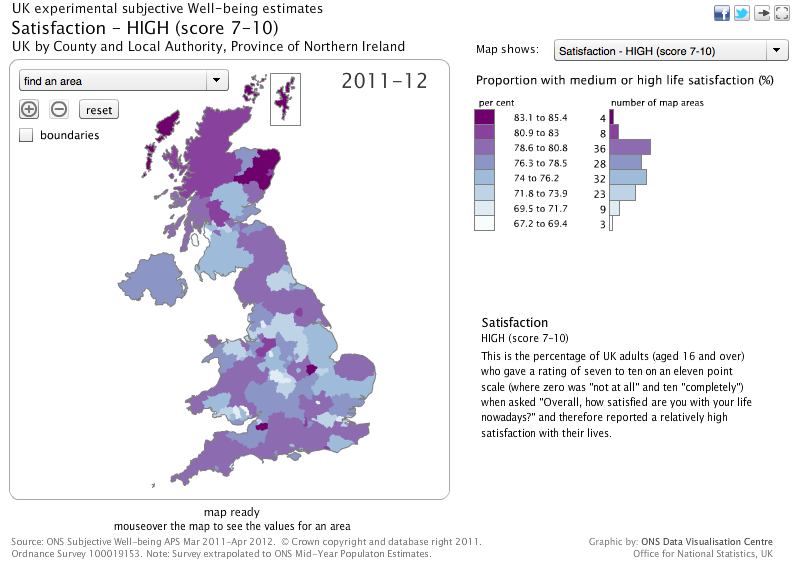
Recently, the New Economics Foundation (nef) produced a report on wellbeing patterns in the UK, showing that people who live in rural areas have a higher rate of wellbeing (happiness, satisfaction with their life) than those in urban areas. Specifically, the highest levels of wellbeing (41%) are found on the small islands off the British Isles as well as the northern/southern coastal extremities of country, whilst the lowest levels of wellbeing (20%) are found in London, Luton and Reading.

So do we need the space, the quiet, the sea to be content? Those may be things I dream of whilst at my desk, but I believe living the rest of my life on the Shetland Islands may not ensure permanent satisfaction. Still, different people adapt to different places, and then the familiarity becomes comforting and satisfying in itself – and hard to leave.

map

A sense of community is promoted as one of the keys to social wellbeing – but is this too stifling in a village, or too disparate in a city? New types of living in the city – such as high-rise, high-density apartment blocks – may affect the type of community interaction that occurs; but community dynamics rely on far more factors, including the social structures set in place like resident associations or neighbourhood centres. There is no reason why a strong feeling of community is unlikely to emerge in a large metropolis.

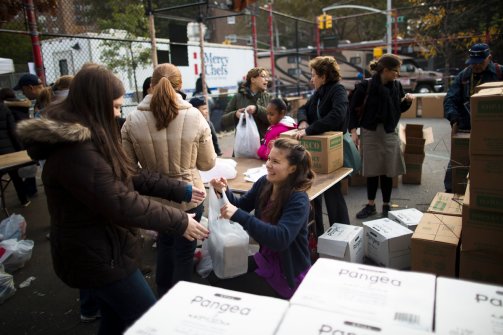
Peter Marcuse recently recently praised the ‘Occupy Sandy’ initiative in New York, noting the way that people helped one another was: ‘an expression of solidarity: it says, essentially, in this place, this city, at this time, there are no strangers. We are a community, we help one another without being asked… we are all parts of one whole.’ Though this unity may have emerged in a time of crisis, it shows that cities are not incapable of a powerful sense of togetherness.

Occupy Sandy

Another social activity strongly tied to the idea of wellbeing is the participation in decision-making in environmental and local affairs. This is certainly not automatically more feasible in small rural communities than cities. At least in the UK, there are numerous structures in place to enable this civic empowerment, but we must always ensure – wherever the community – that this participation is meaningful and not tokenistic.

Rural and urban life I think is too different to be compared; as the percentage of the world population living in cities continues to rise, the question now is more likely what kind of city encourages wellbeing? I would like to see an investigation in to the varying levels of wellbeing between different cities, to understand places that enhance and maximise the opportunities and benefits of urban living. The recent trend for ranking ‘liveable cities’, however, often glosses over many key aspects, complexities and subjectivities.

Moving beyond vital infrastructure for physical health often taken for granted in developed cities, including accessibility to basic services (what we might term ‘objective wellbeing’), we can think of more subtle – but still crucial – ways to support holistic wellbeing in the contemporary city.

one

As I recently discussed, pedestrian-friendly cities – those places which boast ‘walkability’ – encourage greater use of the public realm and result in more social interaction and enjoyment of civic space. Equally, supporting and enhancing access to greenery and nature is crucial to overcoming the challenges to wellbeing presented by a large urban centre.

Furthermore, if urban wellbeing is to be enhanced, it is crucial that the clear benefits of city living – including access to a rich variety of culture – should be fully supported and nurtured rather than forgotten or diminished. Cities also need to maximise on their community initiatives and support networks, as well as opportunities for empowerment and participation; London, though its size may present challenges, benefits from a concentration of wonderful organisations working with the city’s communities to improve lives and places.

Many have claimed that wellbeing is increased by a strong place identity. I believe this notion of place identity has at times been exploited and created by top-down branding efforts for economic benefit; an identity of place which is created collaboratively with the local community, however, holds far more resonance. As more people become involved in civic decision-making, participatory planning and creative interaction, so the ownership of place and space will engender a lasting sense of local pride.

Happiness and satisfaction will always be personal and subjective, as well as vary from day to day – so it is of course difficult to measure wellbeing. What’s more, we cannot anchor wellbeing to place alone – place itself is shaped by the people in it. I do believe, however, and have tried to highlight here, that there are ways in which the people designing and managing cities can support fuller, more active, democratic and creative lives of citizens.  Of course the rest of the work is down to us.

The ‘Cities, health and wellbeing’ conference put forward the power of wellbeing as a point around which to rethink city development and identify more sensitive and intuitive ways of intervening in cities. My only addition to this would be to stress that, more than ‘intervention’, truly sustainable and beneficial efforts will be collaborative and work with citizens to better understand what makes a happier and healthier place.

We need to walk about cities

by Francesca Perry

five

‘I’m becoming the street’ – Frank O’Hara

A large part of how I became so fascinated by cities – namely London – was by walking through them; exploring by foot the possibilities and complexities that such a place could offer. Walking is, for me, associated with a feeling of freedom and discovery. The best way to experience cities is to move through them: bringing yourself to the street and in contact with an immense variety of other lives and places helps you to feel a part of the world and to understand it. Walking is a both a confrontational and comforting way to form a relationship with the city.

In my work we organise ‘walk and talks’ as a key form of consultation for urban development. Our objective is to understand a particular area of the city and how its local community of residents and businesses uses it, interacts with it, and thinks about it. By treading the streets and moving through the places themselves, it uncovers far more than simple conversation. Walking through a place is an illuminating form of communication with – and about – the city.

two

I strongly believe in the power of participation in public life. I don’t believe you can get the most from a city by observing it through a car window. Walking – being connected to the urban fabric – is increasingly important in an age where vehicles intensify human disconnection from space. As Brendan Crain writes, ‘it is within our power to create a better city simply by being present’. Streets come to life when we walk on them.

Part of the freedom I associate with urban walking is the freedom to determine your own route, your own pace, to be accountable only to yourself. The appeal of this lies in the fact that such freedoms are limited in our urban lives – of work, pressures, expectation, commitment. Moving through the streets, as part of the streets, can empower and liberate.

The political potency of walking through the city – occupying the streets, participating in protest marches – has a long history. But these crucial public acts continue to highlight the importance of the freedom and symbolic action that walking through city spaces can offer.

three

Still, this isn’t to say urban walking cannot be detached. There is something comforting about moving through a place anonymously, surrounded by activity. ‘To be a stranger surrounded by strangers, to walk along silently bearing one’s secrets’ Rebecca Solnit writes in Wanderlust: A History of Walking, ‘is one of life’s starkest pleasures.’

The liberation offered by movement, progress, the repetitious beat made on the pavement; all lives continuing, buildings standing, streets stretching on – though you may not be playing an active role, you feel part of something bigger, at home in a place over which you can claim ownership, a place where you can be alone in unity. Walking through the streets, you let the city take the reins. Charles Dickens undertook nocturnal urban walks to cure his insomnia and distress, as documented in Night Walks. There is something particularly special about night walks. They allow for a certain peace and observation; moving through the theatre of the city, watching it, transporting yourself. The city empty, majestic.

Of course there are practical walks – to get from A to B – and there are dedicated walks, or ‘wanders’. This act of walking for the sake of walking, or wandering, was championed by the psychogeographers, who identified their own particular brand of urban walking, the dérive (drift). A journey of unplanned movement throughout the city, the dérive was directed by an instinctive response to place itself.

four

So, how do we embrace this urban experience in planning or managing cities? It is firstly about making ‘walkable’ cities and prioritising pedestrians. Luckily, now we are slowly moving away from building cities for cars, we look towards efforts to nurture and improve the public spaces and streets of cities for people to really interact with. Initiatives such as the pedestrianisation of streets (even if limited to certain days – see Paris on a Sunday), act as an invitation to experience the city on foot. Many organisations are working to improve urban public spaces – such as the Project for Public Spaces or Design Trust for Public Space. Living Streets champions the pedestrian, working to help make better, safer, more walkable streets. The ‘community streets audits’ they undertake engage local communities in collectively thinking about how such street environments can be improved to make more walkable places, beneficial to all.

The website Walkonomics actually rates the walkability of streets in cities, offering an understanding of how pedestrian-friendly different cities and neighbourhoods are or can be. Walkability is of course bound to the notion of liveability in cities: urban walking is not just an experience of enjoyment, it is also – critically – the more sustainable form of urban transport in an age of environmental degradation. This ideal of walkable neighbourhoods – small scale, tight-knit, fine grain and mixed-use – is at the core of much urban planning today (though I don’t agree with their elitist spin on this, the New Urbanists make this point clear as a case for anti-sprawl). We often forget in European cities about the extent of urban sprawl elsewhere: the absolute and total reliance on cars, the expanses of suburban and exurban places where walking is never an option. But not all cities can reflect the intimate and pedestrian-dominated fabric of medieval mediterranean hubs. It is about balance, and responding to context – placing public space and sustainability at the top of the agenda whilst still tending to economic needs.

Brendan Crain draws out the coherent and convincing benefits of walking in the city: improved health, lower transportation costs, more unplanned social encounters, a better sense of purpose and community. This notion of a walkable public realm creating opportunities for chance encounters is also put forward by Jeff Speck in his new book Walkable City. Though we cannot design spaces that ensure social results, it is possible to create environments that facilitate such social benefits or interactions.

Speck’s 10 key ways to creating walkability are succinctly summarised in Kaid Benfield’s article. Beyond what is discussed above, Speck also puts forward the key role of architectural beauty, relatability and landscaping in supporting walkable urban places. The theory of ‘walk appeal’ mentioned in the article begins to refer to the imageability of the city – an urban form that facilitates exploration, navigation and coherence.

Last year I studied strategic and protected views in London. The issue both others and I have found with this planning policy, of a set number of static safeguarded viewpoints in the city, is that this is not the way we experience place at all. We process cities kinetically – we move through it and see cityscapes constantly shifting. Through walking across the city, we understand how it connects, challenging the disconnected experience formed by popping up at tube stops and illuminating new relationships and interstitial landscapes.

Walking embodies the thinking city – it gives you the space, the time and the stimulation to reflect and learn. But the spaces themselves must also be walkable. Beyond striving to create these better streets and public spaces for pedestrians, we perhaps need to help shift attitudes in a car-obsessed culture about the concept and desirability of walking itself. Next time you think about going for a drive, why not try a dérive instead?

end

All photographs are author’s own and all rights are reserved.